
Medical Affairs Career in India: Skills, Scope and Salary - Jobslly Blog

Medical Affairs Career in India: Skills, Scope and Salary

healthcare9 Sept 20264 min read
Share:

Key Takeaways

What you'll learn from this article

  • 1Medical Affairs is a broad function with several career paths.
  • 2Your degree gives you a foundation, but employers assess practical capability.
  • 3Clinical, research and communication experience can become transferable evidence.
  • 4A focused portfolio helps recruiters see what you can do.
  • 5A targeted resume and job search make the transition more focused.

What if the years you spent learning medicine, pharmacy or life sciences could become your advantage outside routine clinical practice?

That is the opportunity behind a Medical Affairs career in India.
You are still using science, but differently: interpreting evidence, communicating with healthcare professionals, supporting medical strategy and bringing field insights back to the organisation.

What Exactly Is Medical Affairs?  

Think of Medical Affairs as the scientific link between an organisation and the healthcare ecosystem. It works with R&D, regulatory, safety, market access and commercial teams while maintaining scientific and medical integrity.

Looking for Healthcare Opportunities?

Browse top-paying jobs in hospitals and clinics worldwide.

Explore Jobs

Area

Typical work

MSL

Scientific exchange, HCP/KOL engagement, field insights

Medical Information

Evidence-based responses to scientific questions

Scientific Communications

Develop and review medical content

Medical Education

Support scientific training

Evidence Generation

Support studies, RWE and publications

Medical Strategy

Convert evidence and insights into plans

One important distinction: MSL is one role within Medical Affairs, not the whole function. 

Who Can Enter a Medical Affairs Career in India?  

There is no single qualifying degree for the entire function. Eligibility is role-specific. Relevant backgrounds can include MBBS/MD/MS, BDS/MDS, PharmD/MPharm/BPharm, PhD and other life-science or allied-health qualifications.

Do not assume every role accepts every degree. Current pharmaceutical positions show different expectations by role and seniority.

Your Degree Already Gives You a Head Start  

Your background

Skills you may already have

Medical Affairs translation

MBBS/MD

Clinical reasoning, disease knowledge

Evidence discussion, medical review

BDS/MDS

Clinical knowledge, communication

Scientific communication

PharmD/MPharm/BPharm

Drug and therapeutics knowledge

Medical information, evidence review

MSc/PhD Life Sciences

Research, literature analysis

Scientific communications, evidence work

Nursing/Allied Health

Patient communication, teamwork

Stakeholder communication

The gap is often not your scientific foundation. It is applying that knowledge in an industry setting.

Medical Affairs Career Growth


Healthcare/Life-science graduate

Build scientific communication + industry skills

Medical Information / Scientific Communications / selected junior roles

MSL / Medical Advisor / specialist role

Medical Manager / Senior Medical role

Medical Affairs Lead / Regional leadership

Director / Global Medical Affairs

This is not a fixed ladder. With experience, you can also move toward clinical development, evidence generation, HEOR, regulatory affairs or global Medical Affairs.

What Is the Salary of Medical Affairs in India?  


Medical Affairs Position

Typical Experience

Indicative CTC in India

Medical Affairs Associate / Executive

0–2 years

₹6–10 LPA

Medical Science Liaison (MSL)

2–4 years

₹8–12 LPA

Medical Advisor

2–4 years

₹10–12 LPA

Senior Medical Advisor

5–8 years

₹12–16 LPA

Regional Medical Advisor

5–8 years

₹12–16 LPA

Medical Affairs Manager

5–8 years

₹12–16 LPA

Senior Medical Affairs Manager

8–10+ years

₹16–24 LPA

Medical Affairs Director / Head

10+ years

₹16–24 LPA


How to Build the Skills Employers Need  

Skill to develop

What you should demonstrate

How Academically can help

Scientific communication

Explain complex evidence clearly

Presentation and communication practice

Clinical evidence

Read trials and literature critically

Evidence-focused learning

KOL engagement

Communicate with senior HCPs

KOL engagement practice

Medical strategy

Turn insights into plans

Medical Affairs strategy training

Medical information

Research accurate responses

Medical information training

Regulatory awareness

Apply relevant requirements

Regulatory/compliance exposure

Portfolio evidence

Show practical capability

Capstone projects and mentorship

Academically’s Executive Programme in Medical Affairs trains you in Medical Affairs fundamentals, KOL management, clinical trials, publication strategy, scientific communication and capstone learning, alongside career support.

Turn Your Skills Into a Resume Recruiters Can Understand  

Do not list only clinical duties. Translate them into industry evidence.

Instead of: “Communicated with patients and doctors.”

Show the transferable capability: “Explained complex treatment information to different healthcare audiences using evidence-based communication.”

Then add proof: research projects, literature reviews, scientific presentations, audits, teaching, publications, conferences, leadership or cross-functional work.

As a fresher, create genuine samples such as a literature evidence brief, scientific slide deck or mock KOL engagement plan. Your resume should be simple, targeted and truthful, with the language aligned to the specific role.

Here's what your resume should look like:
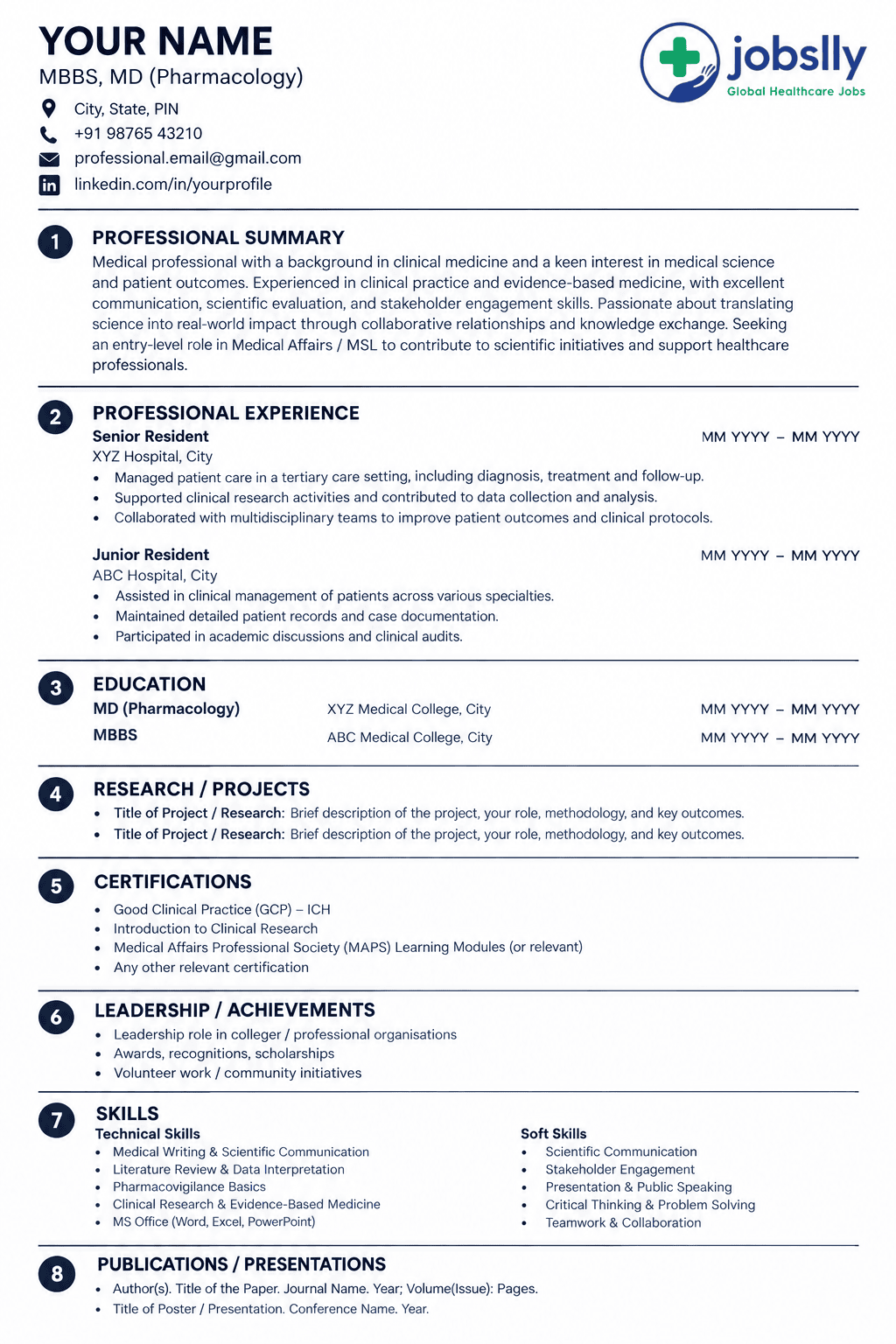
Use your CV as the bridge between your background and the role you want. Jobslly’s resume assistance can support profile refinement, but your strongest differentiator remains clear evidence of relevant skills and practical work.

Find the Right Medical Affairs Jobs  

Search beyond one title.
Use keywords such as Medical Affairs, Medical Science Liaison, Medical Advisor, Medical Information, Scientific Communications, Medical Education and therapy-area terms.

Jobslly currently has a dedicated Medical Affairs category, healthcare-focused listings, resume upload and direct applications. It has verified listings and provides 100% job assistance.


Dr Aditi Chandra

Dr Aditi Chandra

Medical Content Writer Intern | Registered Dentist

Bachelor of Dental Surgery (BDS) | PG Diploma in Hospital & Healthcare Management, Symbiosis University | Fellowship in Endodontics, Saveetha University | Fellowship in Aesthetic Dentistry, Greifswald University

Dr Aditi is a dentist with over four years of clinical and healthcare experience, combining expertise in dentistry, healthcare management, medical communication, and content development. Beyond clinical practice, she has experience creating evidence-based healthcare content, designing patient education materials, and producing digital health communications, with a strong focus on translating complex medical information into clear, accessible, and engaging content for diverse audiences. She is also skilled in healthcare marketing, workflow optimisation, and strategic communication. Currently, Dr Aditi serves as a Medical Content Creator Intern at Academically Global, where she develops educational content for healthcare professionals, students, and international licensing aspirants, committed to delivering accurate, up-to-date, and research-backed information that empowers readers to make informed educational and career decisions.

Frequently Asked Questions

Is Medical Affairs a good career in India?
Medical Affairs can be a strong choice if you enjoy science, evidence-based decision-making and professional communication but want to move away from routine patient care. The field includes Medical Information, scientific communications, education, evidence generation and strategy. Your path can expand as your technical, stakeholder and leadership skills grow.
Can MBBS doctors work in Medical Affairs?
Yes. MBBS and other medical qualifications might be useful to Medical Affairs, especially when clinical knowledge is required. Your degree won’t instantly qualify you for all employment. Other expectations from employers may include scientific communication, evidence interpretation, understanding of therapy areas, stakeholder engagement or industry experience.
Can BDS graduates work in Medical Affairs?
BDS graduates can be considered for selected Medical Affairs and scientific roles, especially when the therapy area values healthcare knowledge. Eligibility varies by employer. Target relevant roles, then strengthen evidence interpretation, scientific writing, presentations and communication.
Can BPharm or MPharm pass-outs work in Medical Affairs?
Yes. Pharmacy graduates can fit roles involving medicines, therapeutics, medical information and scientific communication. Your education gives you useful drug and disease knowledge. To compete more strongly, develop literature evaluation, clinical evidence, scientific communication, stakeholder interaction and compliance skills. Seek out positions that are a match for your educational background and job-ready skills.
Do I need an MD, PharmD or PhD for Medical Affairs?
No single advanced qualification is required across the entire function. Some roles prefer or require advanced medical or scientific credentials, while others accept relevant healthcare or life-science degrees with suitable experience. The employer’s current job description is the best eligibility check. Your qualifications get you considered; skills, experience and role fit shape your competitiveness.
What does an MSL do in Medical Affairs?
An MSL is generally a field-facing scientific professional who engages healthcare professionals and scientific experts through non-promotional scientific exchange. The role can include discussing clinical evidence, gathering external insights and supporting scientific education. Strong MSL candidates need scientific credibility, communication, relationship-building, planning and compliance awareness, not simply a medical degree.
What skills are required for a Medical Affairs career?
Strong candidates commonly need scientific literacy, evidence interpretation, communication, presentation, stakeholder management, organisation and cross-functional collaboration. Current pharmaceutical roles also highlight therapeutic-area expertise, project management, regulatory awareness and clear scientific communication. The exact mix depends on whether you target MSL, Medical Information, medical education, evidence or strategy work.
How can a fresher get into Medical Affairs?
Start by choosing the type of Medical Affairs work you want. Build skills in clinical evidence, scientific communication, presentations and one therapy area. Create portfolio samples, tailor your resume to each role and consider entry pathways such as Medical Information or scientific communications. Then apply through focused healthcare platforms and employer career pages instead of one generic resume.
What is the medical affair scope in India?
The medical affair scope is broader than MSL work. It can include Medical Information, scientific communications, medical education, field medical, evidence generation, clinical development support, publications and strategy. With experience, adjacent opportunities can open in RWE, HEOR, market access, regulatory affairs or global Medical Affairs, depending on the expertise you build.
How to search for Medical Affairs jobs in India?
Begin your search for jobs on healthcare-specific job boards and employment sites for pharmaceutical, biotech and MedTech companies. Jobslly has a dedicated Medical Affairs category and current listings for Medical Science Liaison and Medical Advisor-related roles. Still check each employer’s job description because eligibility, experience, therapy area and location can differ significantly.

Never miss an update

Get the latest healthcare career insights delivered to your inbox.