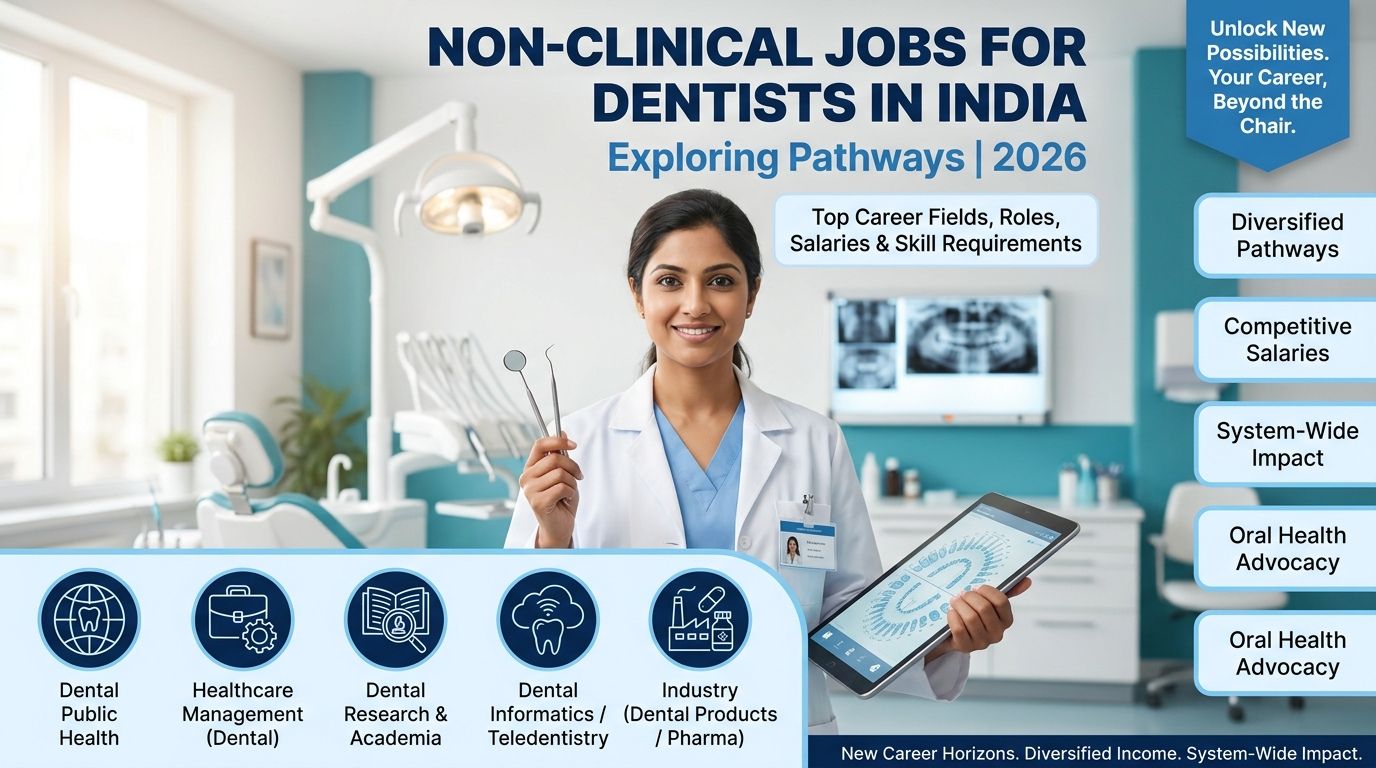
Non Clinical Jobs for Dentists: Your Complete 2026 Career Guide
At some point, a lot of dentists start asking themselves whether the dental chair is really the only destination their degree can lead to. That question used to carry a certain stigma, as if even raising it meant something was wrong with you. It doesn't anymore.
Non-clinical careers for dentists in India have genuinely matured over the last few years. This isn't about doctors burning out and looking for an escape hatch. It's about a growing number of BDS and MDS graduates recognising that the pharmaceutical industry, public health sector, research institutions, and health technology companies all need people who understand clinical dentistry from the inside. And that person is you, far more than you probably realise.
Looking for Healthcare Opportunities?
Browse top-paying jobs in hospitals and clinics worldwide.
This guide covers 10 Non clinical jobs for Dentists that dentists in India are actually working in right now, with honest salary data, who's hiring, what qualifications actually matter, and the parts nobody tends to mention openly. Whether you finished your BDS last year or you've been in practice for a decade, there's a starting point here.
1. Clinical Research Associate (CRA) / Clinical Research Coordinator (CRC)
A CRA's job, in plain terms, is to make sure clinical trials are being run the right way. That means visiting the hospitals and clinics where trials are happening, going through patient records to verify everything was documented correctly, confirming that adverse events were reported as required, and staying in constant contact between the pharma company funding the study and the investigators running it at the site.
A CRC does something similar but stays in one place, which is coordinating participant enrolement, managing paperwork, and keeping the protocol on track at a single research centre. For dentists looking to enter the pharmaceutical world, this tends to be the clearest, most structured path in. There are real training pathways, real hiring pipelines, and the clinical reasoning you already have actually gives you an edge.
Who Hires
Large contract research organisations, multinational pharma companies, and dental device manufacturers all run clinical trials and hire for these roles. The sector is active across India in cities like Hyderabad, Bengaluru, Mumbai, and Pune that have the highest concentration of CRO activity.
What You Need
A BDS degree gets you in the door for entry-level positions. An ICH-GCP certification is effectively non-negotiable and no serious employer will look at your application without it. MDS helps for senior roles involving protocol design, but it is not required to start.
Salary Overview
Experience Level | Salary Range (₹/month) | Typical Employer |
|---|---|---|
Entry Level (0–2 years) | ₹35,000 – ₹45,000 | CRO or mid-pharma |
Mid-Career (3–5 years) | ₹60,000 – ₹1,00,000 | Multinational pharma / CRO |
Senior CRA / Manager (5+ years) | ₹1,20,000+ | Global pharma leaders |
What's Good About It
The skills you build are genuinely transferable internationally. The career ladder is well-defined and transparent. Senior CRAs increasingly work remotely when not on site visits.
What's Harder Than It Looks
Entry-level CRA roles involve a lot of travel , sometimes weekly site visits across cities. The starting salary isn't spectacular. Staying current also means keeping up with regulatory changes, which is a continuous commitment.
How to Get Started
Get your ICH-GCP certification first. It's a short, focused course and the single most important credential for this field. After that, apply to CROs before going directly to Pharma jobs in India; CROs hire more freshers and actually run structured training programmes. A postgraduate diploma in clinical research that includes placement support at CROs is worth considering if you want a more guided entry.
2. Drug Safety Physician / Pharmacovigilance Specialist
Pharmacovigilance which is usually shortened to PV is the work of tracking what actually happens to patients after a drug or device reaches the market. Not everything shows up in clinical trials. Real-world adverse events, sometimes rare and sometimes serious, only surface once a product is in widespread use. The people reviewing those reports need enough clinical background to evaluate them meaningfully.
Day-to-day, the work involves reviewing Individual Case Safety Reports, assessing whether an adverse event is plausibly linked to the drug or dental material in question, preparing submissions to regulatory bodies, and monitoring emerging safety signals. It's analytical, systematic, and genuinely important.
For dentists specifically, this is one of the more accessible transitions. There's a clear training pathway, strong demand at CROs, and your knowledge of dental pharmacology is directly relevant when reviewing cases involving oral medications or dental materials.
Who Hires
Contract research organisations, large pharmaceutical companies with in-house PV units, and dental manufacturers conducting post-market surveillance all employ pharmacovigilance specialists. The field is broad and you're not limited to oral health products.
What You Need
BDS is sufficient for entry. A GCP certification and a short PV-focused training course will make your application stand out considerably. No MDS required.
Salary Overview
Experience Level | Salary Range (₹/month) | Work Setting |
|---|---|---|
Entry Level | ₹25,000 – ₹40,000 | CRO or mid-pharma |
Mid-Career (3–5 years) | ₹55,000 – ₹90,000 | Multinational pharma |
Senior / Global Safety Lead | ₹1,00,000+ | Global pharma / remote |
What's Good About It
Among all the non-clinical paths here, PV probably offers the best work-life balance ,structured hours, no night shifts, and strong remote options at mid-level and above. Career progression is well-defined.
What's Harder Than It Looks
Entry-level work is largely case processing, and there's a lot of it. It can feel repetitive before you move into signal detection or regulatory strategy. Keeping pace with regulatory updates is an ongoing requirement, not a one-time thing.
How to Get Started
Lead with your dental pharmacology knowledge in any application as it's more directly applicable than most candidates realise. A short PV foundation course alongside your GCP certification will meaningfully strengthen your candidacy. Several training providers offer these online.
3. ICMR Research Scientist
The Indian Council of Medical Research is India's apex biomedical research body, employing scientists across its 26 national institutes on everything from oral health epidemiology to infectious disease to health policy. Day-to-day, that means designing study protocols, supervising data collection, running statistical analysis, preparing publications, and contributing to national health recommendations.
This is genuinely prestigious work which is one of the most underexplored career paths among dental graduates in India. Most BDS students simply don't know it's available to them.
Two Distinct Pathways
Option A — Direct PhD After BDS: The DHR-ICMR HRD Scheme for Health Research offers funded PhD positions specifically for BDS graduates within two years of completion. MDS holders are not eligible for this particular route. The programme runs for five years, with stipends at Junior and Senior Resident grade levels, plus a contingency grant of ₹1,00,000 per annum. After completing the PhD, international research fellowship opportunities become available through ICMR's fellowship programmes.
Option B — Scientist 'D' (Dental): For dentists with more experience, this route requires a BDS or MDS from a DCI-recognised institution plus five years of research, teaching, or clinical working experience. The age limit is up to 45 years. Revised ICMR rules now allow BDS+PhD holders to apply for Scientist posts , a relatively recent and significant change that broadened access considerably.
Role | Salary (₹/month) | Notes |
|---|---|---|
ICMR PhD Fellow (BDS route) | Jr./Sr. Resident Grade | 5-year funded programme |
Scientist 'D' (Dental) | ₹78,800 – ₹2,09,200 | Government pay matrix |
Scientist 'E' and above | ₹1,23,100 – ₹2,15,900 | BDS+PhD + experience |
What's Good About It
The salary band is among the highest available to non-clinical dental professionals in India's public sector. The work carries real national-level impact, job security is strong, and international collaboration opportunities come with senior positions.
What's Harder Than It Looks
Entry is competitive and government recruitment timelines can stretch considerably. Research output expectations like publications or grant writing don't diminish once you're in the system.
How to Get Started
Monitor the ICMR website for annual PhD programme announcements and Scientist recruitment notifications. Even one publication during your BDS internship strengthens your application considerably and it's worth pursuing early. The PhD programme announcement typically comes once a year and competition is significant, so being prepared well in advance matters.
4. Medical Affairs / Dental Science Liaison
The Dental Science Liaison (DSL) or Medical Science Liaison (MSL) role is often described as a scientific bridge between a company and the clinical community and that's the most accurate description, but it undersells the substance of the work. You visit senior dental professionals and academics (Key Opinion Leaders), present clinical trial data, discuss therapeutic evidence, and bring field insights back to inform your company's product and research strategy.
This is peer-to-peer scientific exchange, not sales. You need to know your therapeutic area deeply enough that a senior periodontologist or implantologist finds the conversation genuinely worth having.
Who Hires
Major oral care companies, dental device manufacturers, pharma companies with oral health portfolios, and contract research organisations all recruit for these roles. The multinational dental and pharma sector in India is the primary employer.
What You Need
BDS is the minimum. MDS in a relevant specialty is preferred for senior roles. Some companies consider fresh BDS graduates with strong communication skills for junior DSL positions.
Salary Overview
Experience Level | Salary Range (LPA) | Typical Employer |
|---|---|---|
Entry Level (0–2 years) | ₹12 – 18 LPA | Mid-size dental / pharma company |
Mid-Career (3–5 years) | ₹20 – 30 LPA | Multinational dental company |
Senior MSL / Medical Advisor (5+ years) | ₹35 – 50 LPA | Global pharma / dental leaders |
What's Good About It
This is the highest-paying non-clinical entry point for BDS graduates, and the career trajectory into Medical Affairs leadership is strong. No night duties, intellectually engaging work, and you remain embedded in the dental professional world.
What's Harder Than It Looks
If you find sustained social interaction draining, this role will exhaust you because the entire job is high-quality human engagement. The first six to twelve months of building deep therapeutic area knowledge is genuinely demanding, and there is significant travel involved.
How to Get Started
Pick one therapeutic area aligned with your clinical background such as periodontology, endodontics, dental materials and go deep on it before applying. Follow working DSLs and MSLs on LinkedIn to understand how they talk about their work. Apply directly to Medical Affairs divisions rather than through general job boards. An MSL certification course will materially strengthen your candidacy.
5. Hospital Administrator / Healthcare Manager
Hospital administration roles put dentists in a position that few non-medical MBA graduates can honestly claim: genuine clinical credibility alongside operational responsibility. You understand how wards function, why patient flow breaks down, what clinical staff actually need, and how to communicate across clinical and non-clinical teams in ways that make sense to both sides.
Day-to-day, this means managing departmental budgets, coordinating between departments, improving patient flow, handling vendor relationships, ensuring regulatory compliance, and driving quality improvement. In larger networks, senior roles move toward strategic governance and organisational leadership.
Who Hires
Major hospital chains across India, diagnostic networks, and corporate dental clinic groups all recruit operations managers and administrators with clinical backgrounds. The sector continues expanding across tier-1 and tier-2 cities.
What You Need
BDS with clinical experience is the baseline. An MBA in Hospital Administration (MHA) substantially accelerates your trajectory into dedicated management roles.
Role | Salary Range (LPA) | Setting |
|---|---|---|
Hospital Administrator | ₹10 – 20 LPA | Multi-speciality hospital |
Operations Manager (Dental Chain) | ₹8 – 15 LPA | Corporate dental group |
Medical Director | ₹20 – 40 LPA | Large hospital network |
Chief Medical Officer | ₹40 – 70 LPA | Corporate hospital chain |
What's Good About It
Clear leadership identity, strong long-term financial growth, and the option to maintain partial clinical involvement if you want it. India's hospital sector is still in an active expansion phase.
What's Harder Than It Looks
You'll be managing budgets, HR issues, and operational fires every single day. Dentists who entered expecting strategy and leadership often find themselves dealing with a lot of operational friction in the early years. And the distance from direct patient care is real but some people miss it more than they expected.
How to Get Started
Many dentists enter through departmental or clinic manager roles within dental chains first. An MBA or MHA from a well-regarded institution opens the faster track into hospital group management. Look for operations coordinator openings in dental chains as a structured first step.
6. Dental Insurance Consultant
Insurance consulting doesn't get much attention in dentist career conversations, which is odd given how well it suits the analytical side of the profession. The role involves reviewing submitted claims, evaluating whether the procedures claimed match what was documented, identifying inflated or potentially fraudulent cases, advising on dental benefit plan design, and liaising with providers to resolve disputes.
This is entirely desk-based work, often remote, and it draws directly on clinical knowledge that non-dental reviewers simply cannot replicate. Knowing what a crown preparation actually looks like on a radiograph, or what a standard treatment plan for a cracked tooth should involve, fundamentally changes the quality of review work.
Who Hires
Health insurance companies, third-party administrators, and large corporate health benefit programmes all employ dental reviewers and consultants. The sector has grown significantly alongside the expansion of health insurance coverage in India.
What You Need
BDS is standard. Strong analytical instincts and familiarity with dental procedure codes and costs are essential and the clinical knowledge is the differentiator here.
Salary Overview
Role | Salary Range (LPA) | Work Mode |
|---|---|---|
Claims Reviewer / Auditor | ₹6 – 10 LPA | Remote / Office |
Dental Medical Underwriter | ₹8 – 14 LPA | Office-based |
Insurance Examiner / Fraud Investigator | ₹10 – 18 LPA | Hybrid |
Senior Consultant / Manager | ₹18 – 28 LPA | Leadership track |
What's Good About It
Remote-friendly, stable hours, no clinical stress. One of the better work-life balance profiles of all the roles covered here.
What's Harder Than It Looks
Entry-level claim review can be repetitive. You'll also need to become comfortable with insurance regulatory frameworks and billing nomenclature, which takes time if you haven't been exposed to it during practice.
How to Get Started
In your application, foreground your knowledge of dental procedure costs, treatment planning logic, and clinical documentation standards , those are exactly the skills insurers are paying for and that non-clinical reviewers cannot match.
7. Forensic Odontologist
Forensic odontology sits at the crossroads of dentistry and criminal justice, and there's nothing quite like it elsewhere in healthcare. The work involves identifying human remains from dental records when other identification methods fail, analysing bite mark evidence in assault cases, estimating age from tooth morphology, and providing expert testimony in court proceedings.
In India, forensic odontologists are called upon by the CBI, state police forensic divisions, AIIMS forensic departments, and disaster victim identification teams. International practitioners work with INTERPOL's DVI operations. It's niche work, intellectually demanding, and for the right person it is remarkably fulfilling.
Who Hires
State forensic science laboratories, the Central Forensic Science Laboratory, the CBI, AIIMS forensic medicine departments, dental colleges with forensic departments, and international disaster victim identification teams. The field is growing in India as forensic infrastructure expands.
What You Need
BDS is the baseline, but a formal certification in forensic odontology is essential for both professional credibility and for acceptance as an expert witness in court proceedings. Several institutions in India offer these qualifications, including fellowship programmes at dental universities and professional body certifications through the Indian Association of Forensic Odontology. Duration typically ranges from a few months to one year depending on the format.
Salary Overview
Role | Salary Range (LPA) | Setting |
|---|---|---|
Forensic Consultant (State Lab) | ₹6 – 12 LPA | Government |
CFSL / CBI Forensic Expert | ₹12 – 20 LPA | Central government |
Academic + Forensic Consultant | ₹10 – 18 LPA | Dental college + field |
What's Good About It
Genuinely unique work combining dentistry with investigation and legal process. India's forensic infrastructure is growing, and demand for qualified practitioners is real.
What's Harder Than It Looks
This is still a developing field in India. Full-time, standalone forensic odontology positions remain limited. The majority of practitioners combine forensic consultancy with academic work or limited clinical practice. It is not a direct replacement for a clinical income at the start.
How to Get Started
The fellowship certification offered by the Indian Association of Forensic Odontology is the most credible Indian qualification in this field. Connect with forensic medicine departments at AIIMS and state forensic labs early offering to assist on cases even without immediate compensation builds a case portfolio that matters enormously when formal roles open up.
8. Dental Public Health Specialist
Public health dentistry shifts the entire scale of impact. Instead of treating one patient at a time, you're designing programmes that affect thousands or millions of people, oral disease prevention initiatives, epidemiological surveys, school dental health campaigns, government policy recommendations, community outreach. The clinical decisions give way to population-level thinking.
It's also one of the more internationally mobile dental careers. WHO, UNICEF, and international NGOs employ dental public health professionals, and the demand for people who understand both clinical reality and population data is genuine.
Who Hires
National Health Mission India, ICMR, WHO India country office, UNICEF, state health departments, major public health foundations, and international development organisations. Post-pandemic attention to oral health in public health systems has increased hiring meaningfully in this sector.
What You Need
BDS plus a Master of Public Health is the standard pathway for substantive roles. Field-level government positions may accept BDS with clinical experience, but for anything beyond that, an MPH is close to essential. Strong institutions offering this degree in India include TISS and IIHMR University.
Salary Overview
Employer Type | Salary Range (LPA) | Geographic Scope |
|---|---|---|
Government / NHM field roles | ₹6 – 12 LPA | India-based |
ICMR / NCDC research roles | ₹8 – 16 LPA | India-based |
NGO / Foundation | ₹12 – 22 LPA | India + international |
WHO / UNICEF | ₹20 – 35 LPA | International postings |
What's Good About It
Meaningful, visible population-level impact. Strong international career mobility. The field has grown in prominence since the pandemic highlighted gaps in oral health within broader public health systems.
What's Harder Than It Looks
Government roles involve bureaucratic processes and salary progression can be slow. International organisation positions are intensely competitive, candidates typically have strong research backgrounds and multiple degrees.
How to Get Started
An MPH from a well-regarded institution is the clearest path into serious roles. Government dental officer positions under state health missions and ICMR fellowship opportunities are the best entry points for fresh BDS graduates. Monitor government recruitment portals regularly — these positions don't stay open long and intake is annual.
9. AI & Health Technology Specialist
Health technology companies are building AI tools that analyse dental radiographs, flag pathology, assist with treatment planning, and automate clinical documentation and they have a fundamental problem. The engineers building these products don't know what a carious lesion actually looks like on an X-ray. They need dentists in the room.
In practice, that means annotating dental images to train machine learning models, reviewing AI diagnostic outputs for clinical accuracy, writing product requirement documents, and serving as the interface between software teams and clinical reality. It's the fastest-growing segment of non-clinical work for dentists right now, and the range of roles from freelance annotation to Chief Dental Officer is broader than most people expect.
Who Hires
Dental AI startups operating globally and in India, health technology platforms, large dental product companies building digital divisions, and data labelling companies that work with medical imaging. The ecosystem is expanding quickly, particularly in the dental radiograph analysis space.
What You Need
BDS is sufficient. Genuine comfort with technology and basic data literacy matter more than additional qualifications. Curiosity about how AI actually works in clinical contexts is something interviewers notice and value.
Salary Overview
Role | Salary Range (LPA) | Notes |
|---|---|---|
Dental AI Annotator (Freelance) | ₹3 – 8 LPA | Remote, flexible hours |
Clinical Product Advisor (Startup) | ₹10 – 18 LPA | + equity in early-stage firms |
Clinical Product Manager | ₹15 – 30 LPA | Product-tech interface role |
Chief Dental Officer (Startup) | ₹30 – 50 LPA+ | Leadership in funded firms |
What's Good About It
The growth trajectory here outpaces every other option on this list. Remote-friendly at almost every level. Early-stage startup roles come with equity upside that can be meaningful if the company grows.
What's Harder Than It Looks
Startup risk is real , companies fold, funding rounds dry up, teams dissolve. Roles are less structured than anything in pharma. If you prefer predictable, well-defined work, this environment will frustrate you.
How to Get Started
Freelance dental image annotation work through data labelling platforms is the lowest-barrier entry point , it builds your portfolio and puts your name in front of companies who need dental expertise. Health informatics courses available on major online learning platforms help round out your candidacy for product roles. Engage with dental health-tech companies before you apply ,being a familiar name in the space makes a real difference.
10. Medical Writer / Dental Content Specialist
Every drug approval, every device clearance, every published clinical trial rests on a large stack of documents which are clinical study reports, regulatory submissions, patient information leaflets, journal manuscripts. Those documents have to be scientifically accurate, precisely structured, and written in the specific language that regulators and journal editors expect. That's what medical writers do.
For dentists, this is perhaps the most flexible non-clinical option available. Fully remote, strong freelance opportunities, and the dental and pharmacological knowledge you already have is directly applicable. It's not glamorous work, but it is genuinely skilled and well-compensated at mid and senior levels.
Who Hires
Contract research organisations, pharmaceutical companies' regulatory affairs divisions, medical communications agencies, dental journals, and digital health platforms all employ medical writers. Freelance opportunities are also substantial once you have a portfolio established.
What You Need
BDS is sufficient. Strong written English, careful attention to detail, and a solid understanding of research methodology are the real requirements. No MDS needed.
Salary Overview
Experience Level | Salary Range (LPA) | Work Setting |
|---|---|---|
Entry Level | ₹4 – 8 LPA | CRO or medical comms agency |
Experienced (3–5 years) | ₹10 – 18 LPA | Pharma / CRO / freelance |
Senior / Specialist Freelance | ₹20 LPA+ | Remote / self-employed |
What's Good About It
This is the most schedule-flexible non-clinical career on the list, especially once you move into freelance work. No travel, no clinical stress, suits people who think carefully and write precisely.
What's Harder Than It Looks
Entry salaries are the lowest of all the paths here. Regulatory writing specifically has a steep learning curve. Career progression requires genuine specialisation in a particular document type or therapeutic area here generalists tend to plateau fairly early.
How to Get Started
Build a writing portfolio before you apply anywhere. A mock clinical study synopsis or a well-written review article on a dental topic you know deeply is a concrete demonstration of ability. Apply to medical communications agencies and contract research organisations simultaneously. Search job portals using terms like 'medical writer' and 'regulatory writer' alongside your dental background.
Non-Clinical Jobs for Dentists: At-a-Glance Comparison
Career | BDS Entry? | Salary Range (LPA) | Work-Life Balance | Best For |
|---|---|---|---|---|
Clinical Research (CRA/CRC) | Yes | ₹4 – 15+ | ★★★ | Research-oriented |
Pharmacovigilance | Yes | ₹3 – 12+ | ★★★★★ | Detail-oriented |
ICMR Scientist | Yes (PhD route) | Govt. Scale | ★★★★ | Research/academia |
Dental / Medical Science Liaison | Yes | ₹12 – 50 | ★★★★ | Communicators |
Hospital Administration | Yes (MBA helps) | ₹10 – 70 | ★★★★ | Leaders/ops |
Insurance Consultant | Yes | ₹6 – 28 | ★★★★★ | Analytical, remote |
Forensic Odontology | Yes + Cert | ₹6 – 20 | ★★★ | Investigative |
Dental Public Health | BDS + MPH | ₹6 – 35 | ★★★★ | Policy/global |
AI & Health Tech | Yes | ₹3 – 50+ | ★★★★ | Tech-curious |
Medical Writing | Yes | ₹4 – 20+ | ★★★★★ | Writers/remote |
The Honest Challenges of Making This Transition
The Identity Piece Is Real
For many dentists, the degree isn't just a qualification, it's a significant part of how they see themselves professionally. Walking away from direct patient care, even partially, can be more disorienting than expected. That sense of immediate purpose that comes from finishing a complex restoration or relieving someone's pain doesn't have a direct equivalent in a pharma office or a regulatory affairs team. This isn't a weakness, and it's not a sign you've made the wrong decision. Many dentists navigate it by keeping a part-time weekend practice during the transition which also protects income while you build new skills.
Entry-Level Pay May Not Be What You're Expecting
Not every non-clinical role immediately pays better than clinical practice. Medical writing entry salaries sit at ₹4–8 LPA, which may be lower than what you're earning in an established clinic. Pharmacovigilance starting salaries are reasonable but not dramatically higher than junior clinical pay. The financial argument for non-clinical careers is a medium-term one and at the five to seven year mark, the gap opens significantly in favour of most non-clinical paths. But the first couple of years require honest financial planning.
Picking the Right Role for the Right Reasons
A dentist who finds extended social interaction draining will not thrive as a Dental Science Liaison, where relationship-building is essentially the whole job. A dentist without genuine interest in data will find pharmacovigilance dull within six months. And a dentist fundamentally motivated by being the person who solves someone's problem that day may find the distance from clinical outcomes in regulatory or consulting roles genuinely difficult over time. The comparison that matters isn't just salary, it's whether the day-to-day reality of the role fits who you actually are.
The Social Pressure Is Real in India
Non-clinical careers for dentists are still poorly understood by both within the profession and among the families of BDS graduates. The expectation to either pursue MDS or stay in clinical practice is strong, and dentists exploring alternatives often encounter skepticism from peers and concern from family members who equate a non-clinical role with a step backwards. The most effective counter to this is direct: conversations with dentists already working in these roles, who can speak to reality rather than theory.
The Transition Takes Longer Than People Want
Most dentists who successfully make this move spend six to eighteen months building the skills, network, and application portfolio needed to land their first non-clinical role. Expecting an overnight pivot without additional certifications or industry exposure is usually a route to frustration. The transition is genuinely achievable but it is a deliberate process, not a quick switch.
A 5-Month Transition Roadmap
Month 1: Figure Out Where You're Actually Headed
Before you look at any certification or update your CV, spend time on genuine self-assessment. Do you prefer working with data or with people? Are you energised by science or strategy? Do you want to stay connected to oral health specifically, or are you open to broader healthcare? Do you want to travel, or do you want to stay at a desk?
Map those answers against the roles above and shortlist two or three that genuinely fit. This matters more than any course you could take — have three to five real conversations with dentists already doing those jobs. Reach out on LinkedIn. Most are willing to talk for twenty or thirty minutes. What you learn in those conversations will save you months of misdirected effort.
Months 2–3: Go Deep on One Relevant Skill
Pick one certification that directly supports your target role and commit to completing it properly:
Clinical research or pharmacovigilance — ICH-GCP certification, widely available through several accredited training providers
Forensic odontology — fellowship certification through the Indian Association of Forensic Odontology or a university-based programme
Hospital management — MBA from a well-regarded health management institution
Medical writing — a short postgraduate certificate in medical writing, combined with building a writing portfolio
AI and health technology — a health informatics course available on major online learning platforms
One thing at depth is far more convincing to employers than five half-finished credentials. Resist the temptation to collect certificates.
Months 3–4: Build Something to Show
Part-time involvement in your target field ,wherever possible changes the quality of your application. Freelance medical writing assignments, dental image annotation through data labelling platforms, participation in hospital management committees , all of these create a portfolio that demonstrates real commitment rather than aspiration.
At the same time, build your LinkedIn presence with genuine intent. Follow hiring managers at pharma companies, engage with dental industry content, connect with CRO recruiters. The majority of non-clinical dental jobs in India are filled through professional networks. Job boards are a secondary channel.
Months 4–5: Apply — With the Right CV
Rewrite your CV from scratch for the industry you're targeting. Submitting a clinical CV to a pharma company is the most common mistake dental graduates make at this stage, and it rarely gets past the first screen. Reframe your experience in terms that resonate in a corporate setting: your ability to synthesise complex clinical information, your communication with patients and colleagues, your research or writing background, your analytical training.
Apply to five to ten roles simultaneously across pharma companies and CROs. Use job portals including Naukri and LinkedIn Jobs, along with the ICMR recruitment portal and relevant government recruitment notifications. Keep your dental registration active throughout as it remains a professional asset and keeps options open.
Conclusion
Non-clinical careers for dentists are no longer a niche conversation or a fallback option. They are real, structured, well-paid, and increasingly in demand across sectors that India's healthcare economy continues to expand into. That said, they are not for everyone, and this guide has tried to be honest about that rather than paint an unrealistically smooth picture.
If you're driven by scientific curiosity, strategic thinking, communication, technology, or the idea of impact at scale rather than individual patient encounters ,these paths offer things that clinical practice alone cannot. The decision to move in this direction is significant enough to deserve more than a quick read. It deserves research, honest self-reflection, and actual conversations with dentists who've already made the journey.
The best first step isn't a certification or a course. It's a twenty-minute conversation with someone already doing the job you're considering.