
Have you ever wondered who answers a physician’s urgent call when a patient experiences an unexpected side effect, or when a clinical team needs raw scientific facts, free from marketing spin?
That is exactly what you would do if you were to work as a Medical Information Specialist.
If you have a deep love for pharmacology but feel exhausted by repetitive clinical tasks or routine dispensing, this role opens a whole new pathway. It is tailored for anyone with an analytical mind and a passion for research who wants to impact thousands of patients behind the scenes, operating right at the dynamic intersection of medicine, evidence, and strategy.
Looking for Healthcare Opportunities?
Browse top-paying jobs in hospitals and clinics worldwide.
What is a Medical Information Specialist?
Picture an oncologist calling a pharmaceutical company at 9:00 AM asking, "What does clinical trial data say about using this drug in patients with renal impairment?"
As a Medical Information Specialist, your job isn't to sell a product. You step in to research approved product literature, evaluate clinical trials, distil findings into clear, compliant responses, and carefully document every interaction.
A Medical Information Specialist is a professional within the pharmaceutical or healthcare industry who researches, evaluates and communicates evidence-based, accurate, balanced and non-promotional information about medicines and medical products in response to medical enquiries. |
Do not confuse it with medical records work
Do not get tripped up by overlapping job titles online. The U.S. Bureau of Labor Statistics describes medical records specialists as professionals who compile, process and maintain patient files, including coding diagnoses and procedures and managing health-record data. Medical Information Specialists focus strictly on scientific data, clinical inquiries, and regulatory-compliant communication.
What does a Medical Information Specialist do?
Work area | Your typical responsibility |
Medical enquiries | Answer HCP, patient, caregiver or internal questions |
Literature | Search, evaluate and synthesize scientific evidence |
Response content | Create/update standard responses, FAQs and scientific summaries |
Safety/product issues | Recognize and route adverse events or product complaints |
Medical review | Check accuracy, balance, references and compliance |
Systems | Log and track enquiries, responses and approved content |
Collaboration | Work with Medical Affairs, PV and Regulatory |
The medical-information workflow
Question received ↓ Triage ↓ Check label/approved content ↓ Literature search ↓ Appraise evidence ↓ Draft response ↓ Review/approval ↓ Respond ↓ Document ↓ Escalate/report when required |
(Enterprise tools like Veeva manage this complete workflow; from initial intake and case management to content fulfilment and closure.)
Medical Information Specialist skills employers want
The core skill stack is scientific knowledge + literature searching + critical appraisal + medical writing + compliance + communication + documentation + digital-system fluency. |
Is Medical Information a good career in 2026?
If you want an evidence-based career that balances deep scientific research with real-world clinical impact, the short answer is yes.
But let’s look past just the job label for a moment.
The truth about building a long-term career in pharma and healthcare is that: no single job title is inherently "right" or "wrong". It is the transferable skills you learn that build a progressive, future-proof career throughout your life.
When you enter Medical Information, you are stepping into a high-value skill incubator.
If you enjoy scientific writing, literature research, and critical evidence appraisal, this field offers a launchpad to build expertise that employers across the entire healthcare ecosystem desperately need.
Why The Title Is Less Important Than The Skill Set
In a Medical Information position, you master:
Deep Literature Review: Evaluating trial design, detecting data bias, and synthesising complex scientific literature into clear solutions.
Scientific Writing: Writing compliant content from raw clinical evidence to balanced, non-promotional papers for healthcare professionals and patients.
Regulatory & Safety Awareness: Real-time adverse event or product complaint identification and navigating tight compliance standards.
Cross-Functional Fluency: Direct interaction with Medical Affairs, Pharmacovigilance and Regulatory teams.
These are not just "MIS skills", they are the foundational pillars of the entire pharmaceutical sector.
If you are looking for a structured path to build this exact skill stack, comprehensive training like Academically’s Executive Program in Medical Affairs is designed to teach these core competencies end-to-end.
Mastering these skills means you are never stuck.
Whether you choose to grow within Medical Information, transition into a field-facing Medical Science Liaison (MSL) role, lead Medical Affairs strategy, or pivot into clinical trial writing, your career trajectory remains firmly in your hands.
Who can become a Medical Information Specialist?
Background | Typical fit |
PharmD / Pharmacy | Strong fit for drug-information roles |
MBBS, MD | Strong clinical/scientific fit |
PhD, life sciences | Strong evidence/research fit |
BDS, MDS | Strong research fit |
MSc, relevant life sciences | Possible where accepted |
Nursing/allied health | Possible depending on role |
Medical Information Specialist roadmap: how to become one
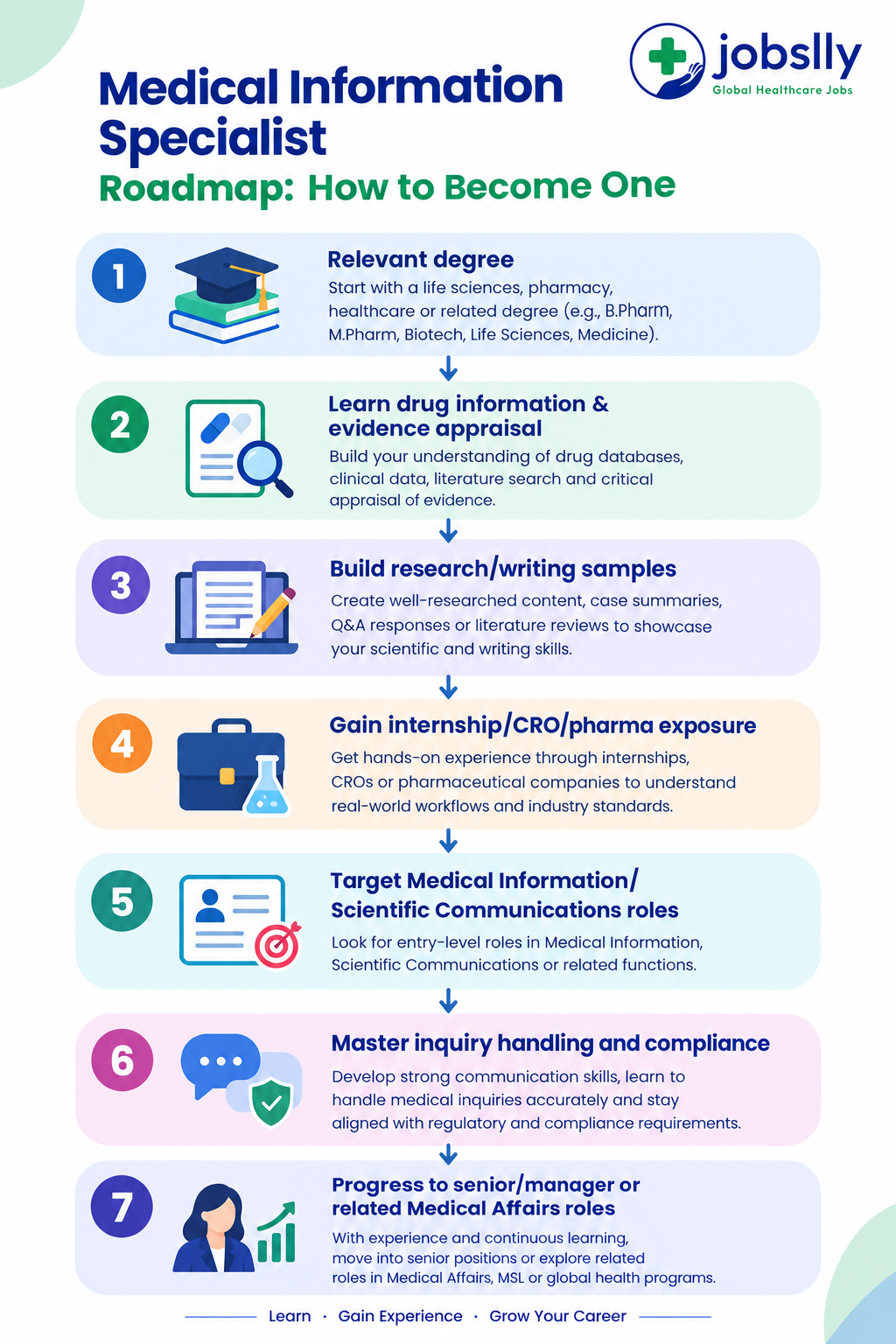
Before applying, build three proof points:
a literature-search sample,
a short medical-information response using evidence, and
a piece showing you can simplify complex science accurately.
Medical Information Specialist jobs: where can you work?
When job hunting, don't limit yourself to one exact search query. Employers across pharmaceutical multinationals, Contract Research Organizations (CROs), biotech firms, and medical device companies post these positions under several related titles:
Medical Information Analyst or Associate,
Medical Information Writer,
Scientific Communications, and
Medical Information Manager.
You can find openings by manually visiting individual company career portals, but sitting for hours with 10 different tabs open across company sites, LinkedIn, and Naukri quickly becomes a headache.
A much easier route is using Jobslly.
It is dedicated solely to healthcare employment; it unites all top pharma, CRO and biotech listings under one roof.
Instead of juggling multiple passwords and spreadsheets, you can:
Stop the tab overload: Search and read filtered healthcare-only listings in one single site.
Stay organised: Track all your job applications in one dashboard.
Simplify your process: Sign up, customise your CV, apply, and track your progress with ease.
Medical Information Specialist Salary
Experience Level | Years of Experience | Salary Range (INR Per Annum) | Common Job Titles |
Entry Level | 0 – 2 Years | ₹3.5 LPA – ₹6.5 LPA | Medical Information Associate, Scientific Content Analyst, Trainee MIS |
Mid Level | 3 – 5 Years | ₹6.5 LPA – ₹12.0 LPA | Medical Information Specialist, Senior Scientific Communications Analyst |
Senior Level | 5 – 10 Years | ₹12.0 LPA – ₹18.0 LPA | Senior MIS, Lead Medical Information Specialist, Sub-Team Lead |
Leadership / Executive Level | 10+ Years | ₹18.0 LPA – ₹28.0+ LPA | Medical Information Manager, Lead Medical Affairs Manager, Head of MIS |
Factors Influencing Your Pay Scale
Educational Qualification
Employer Type
Geographic Hubs
Medical Information career growth
Junior/Associate ↓ Medical Information Specialist ↓ Senior Specialist ↓ Manager/Lead ↓ Director/Head |
You can also move into Medical Affairs, Medical Writing, Pharmacovigilance, Regulatory Affairs or MSL/field medical.
Ready to Put Your Scientific Skills to Work?
If you already possess a strong foundation in life sciences, pharmacy, or clinical research and feel confident in your ability to analyse data and communicate science clearly, your next opportunity is waiting.
Browse through thousands of active job options across top pharma, biotech, and CRO companies to find the role that fits your experience on Jobslly.
Looking for Medical Information Specialist opportunities?
Browse thousands of opportunities on Jobslly
Explore Medical Information Specialist Jobs →