AI-powered · Free
AI ATS resume checker for healthcare jobs
Our AI reads your resume like an applicant tracking system and a recruiter would, compares it with the job description and gives you an AI ATS score out of 100, with the missing keywords and exactly what to fix.
Made for healthcare roles: staff nurses, doctors, pharmacists, drug safety and pharmacovigilance, clinical research, lab and radiology technicians, physiotherapists and medical coders.
- 1Your resume
- 2Job description
- 3AI analysis
- 4Report
Upload your resume
PDF or Word (.docx). We read it the way an applicant tracking system does.
Private: your resume is read in your browser, not uploaded or stored.
How the AI ATS checker works
Three steps and about a minute.
- 1
Upload your resume
Our AI parses your PDF or Word resume the way an ATS does: sections, titles, dates, skills and contact details.
- 2
Paste the job description
The AI pulls out the job title, required skills, qualifications, certifications and years of experience.
- 3
Get your AI ATS score
A score out of 100 across 9 areas, the keywords you are missing and a list of fixes in order of impact.
What you get in your report
More than a number: an AI review of your resume against the exact job.
AI keyword detection
Hard and soft skills from the job, with how often the job and your resume use each one, and which are must-haves.
Semantic skill matching
ICU and critical care, Pharm.D and Doctor of Pharmacy, BLS and Basic Life Support: the same skill counts however it is written.
AI ATS parse preview
See what an ATS reads from your resume: name, headline, contact details, jobs, education. If it is wrong here, an ATS may get it wrong too.
AI verdict and recruiter view
A short summary of your strengths and gaps for this job, plus recruiter tips such as seniority and LinkedIn.
23 pass/fail checks
Contact details, sections, single-column layout, dates, bullet points, numbers, action words, weak phrases and clichés.
Private by design
Your resume is read in your browser. It is not uploaded to our server or stored anywhere.
How your ATS score is calculated
Our AI ATS engine checks your resume against the job description on the same things an applicant tracking system and a recruiter look at. Every point in your report comes from one of these checks. Because skills matter most to an ATS, a resume written for a different kind of job is capped at a low score however well it is formatted.
Hard skills & keywords
30 pointsThe skills, tools, procedures and terms the job uses (ICU, IV cannulation, MedDRA, GCP…) found in your resume, including common synonyms. Requirements and terms the job repeats count more; nice-to-haves count less; near matches get partial credit.
Keyword placement
5 pointsWhether your matched skills appear in your experience and summary, where you used them, and not only in a skills list.
Soft skills
5 pointsThe soft skills the job names (communication, leadership, attention to detail…) shown in your resume.
Job title
10 pointsWhether your headline or most recent job title matches the job’s title. A senior role is also checked for signs of leadership.
Relevant experience
10 pointsYears of related work, counted from the dates of jobs that match this role, against the years the job asks for.
Education, certifications & licence
10 pointsThe degree the job asks for (a higher degree in the same field counts), the certifications it names (BLS, ACLS, GCP, CPC…) and your council registration where needed.
Sections & contact
10 pointsEmail, phone and city at the top, plus the sections an ATS looks for: summary, experience, education and skills.
Formatting & ATS readability
10 pointsReal text (not a scanned image), standard headings, a single column, consistent dates, bullet points and a sensible length.
Writing quality
10 pointsNumbers in your bullet points, action words, no “I/my”, no weak phrases (“responsible for”) or clichés (“hardworking”), short bullets and varied verbs.
Why healthcare resumes get filtered out
The issues our AI ATS checker finds most often, and how to fix each one.
Different words for the same skill
The job asks for “IV cannulation” and the resume says “venous access”. An ATS often counts only the job’s own words.
No registration number
Many hospitals filter on council registration. Put the council name and number near the top.
A generic job title
“Healthcare professional” instead of “Staff Nurse – ICU”. A matching title is one of the strongest ranking signals.
Missing dates
Without a month and year for each job, an ATS cannot count your years of experience and may rank you as a fresher.
Two columns, tables or images
Some ATS read columns in the wrong order or skip text inside tables and images, so your skills go missing.
Duties instead of results
“Responsible for patient care” says little. “Cared for 6 to 8 ICU patients per shift” ranks better and reads better.
How to make your resume ATS-friendly
Most hospital chains, CROs and pharma companies screen applications with an ATS before a person reads them. These habits keep your resume in the shortlist.
- Use the job’s own words. If the job says “IV cannulation” or “ICSR case processing”, write it that way in your skills and bullet points, not a synonym.
- Match the job title. Put the role you are applying for in the headline under your name, when it fits your experience.
- Show registration clearly. Council name and registration number near the top. Many healthcare jobs filter on it.
- Date every job. Month and year for start and end, so the ATS can count your years of experience.
- Keep the layout simple. Real text, standard headings (Experience, Education, Skills), no text inside images, one or two pages.
- Add numbers. Patients per shift, beds, cases a day, targets met: they rank well and impress recruiters.
ATS keywords for healthcare roles
Skills recruiters commonly search for in each role. Use the ones that are true for you, in the job’s own words, and check your resume against the real job description above.
Staff nurse
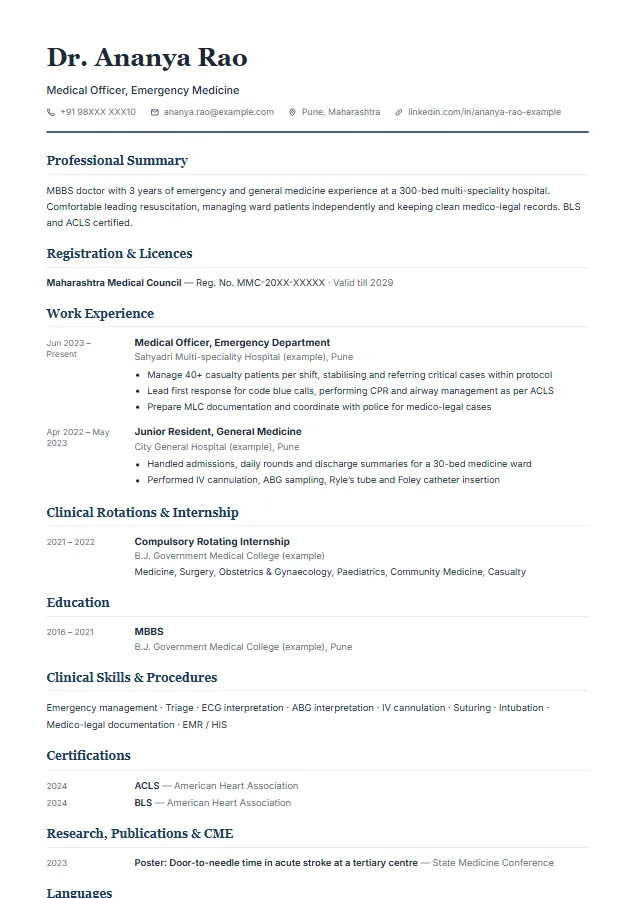
Doctor (MBBS / MD)
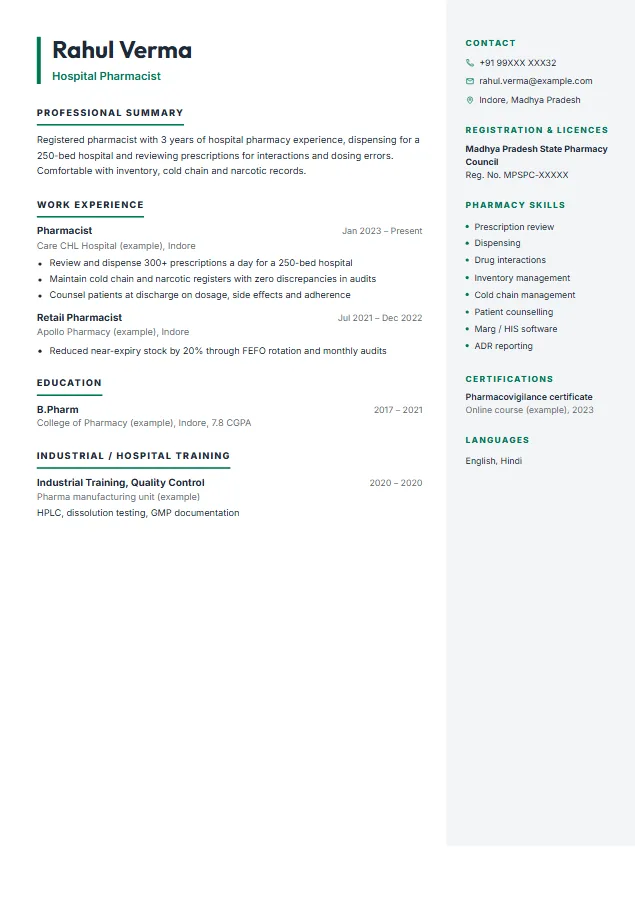
Pharmacist
Pharmacovigilance
Clinical research
Physiotherapist
Lab technician
Medical coder
Need an ATS-friendly resume to start with?
The free Jobslly Resume Builder has 25 healthcare templates (nurse, doctor, pharmacist, pharmacovigilance and more) that ATS software reads cleanly.
ATS resume checker: questions
How does the AI ATS checker work?+
Our AI reads your resume the way an applicant tracking system does: it finds your sections, job titles, dates, skills and contact details. It then reads the job description, picks out the skills, qualifications and requirements, matches the two (including synonyms such as ICU and critical care) and scores the match across 9 areas, with a fix for every gap.
What is an ATS score?+
An ATS (applicant tracking system) is the software hospitals, pharma companies and recruiters use to collect and sort applications. An ATS score estimates how well your resume matches one job description: the more of the job’s keywords, title, experience and qualifications your resume shows, the higher you rank when a recruiter searches or sorts applicants.
Is this ATS resume checker free?+
Yes. You need a free Jobslly account to see your report (it takes under a minute), and then you can check as many jobs as you like.
Is my resume uploaded or stored?+
No. Your resume is read inside your own browser and compared there. It is not uploaded to our server or stored anywhere, and the job description stays on your device too.
What is a good ATS score?+
Aim for 75 or more for a job you really want. 50 to 75 is a fair match that usually needs a few keywords and a clearer title. Under 50 means an ATS is likely to rank the resume low for that job.
Why is my score different for each job?+
Because the score is always measured against one job description. A nurse resume can score 85 for an ICU staff nurse job and 40 for a pharmacovigilance job. Tailor your resume to each job you apply for.
How do I improve my ATS score?+
Start with the fixes at the top of your report: they add the most points. Usually that means adding missing keywords you genuinely have (in your skills and in your job bullet points), using the job’s title in your headline, writing your degree and registration clearly, and adding dates to every job.
Does a PDF or Word resume work better with ATS?+
Both work if the file has real, selectable text. Avoid scanned images, text inside pictures and tables for the main content. Resumes made with the Jobslly Resume Builder are text PDFs with standard headings, which ATS software reads easily.
Should I add keywords I do not have?+
No. Only add skills and experience that are true. Recruiters check, and interviews will ask about them. Use the report to make sure the work you really do is written in the words the job uses.
Do hospitals and pharma companies in India use ATS software?+
Many do, especially large hospital chains, CROs, pharma and medical device companies and recruitment firms. Smaller clinics often read resumes by hand, but a clear, keyword-matched resume helps there too: recruiters skim for the same things.
What does an ATS look for in a nurse or doctor resume?+
Your role title, years of clinical experience, departments (ICU, OT, emergency), the procedures and skills the job lists, your degree (GNM, B.Sc Nursing, MBBS, MD), certifications such as BLS and ACLS, and your council registration.
Can it read a scanned resume?+
Only if the PDF has real text. A scanned image or a photo of a resume has no text for an ATS to read, and the checker will tell you so. Save your resume from Word or Google Docs as a PDF, or rebuild it in the Resume Builder.
How is this different from the Resume Builder’s job match?+
The Resume Builder’s match check lists missing keywords while you edit. The ATS checker is a full report on any resume file: keywords with how often they appear, job title, experience, education, formatting and writing, with a score and fixes in order of impact.