Behind every lifesaving prescription on a pharmacy shelf is an astonishing decade-long voyage, a journey of billions in investment, relentless scientific trials, and the synchronised precision of thousands of people working well beyond the medical room.
A degree in medicine, pharmacy or life sciences gives a good basis of scientific knowledge, but entering the pharmaceutical industry brings a different reality: being excellent in academia is not sufficient.
Today’s companies want operational fluency in Good Clinical Practice (GCP), structured data pipelines, standardized clinical documentation, and sophisticated regulatory submissions.
Drug development is far more than clinical research alone, encompassing all aspects of the lifetime of a therapeutic molecule - from early pre-clinical evidence and safety assessment, to human clinical trials, to regulatory agency reviews, to market approval and continued post-marketing surveillance.
Looking for Healthcare Opportunities?
Browse top-paying jobs in hospitals and clinics worldwide.
What Is the Clinical Drug Development Process?
Drug discovery → Preclinical testing → Phase I → Phase II → Phase III → Regulatory submission → Approval → Phase IV/post-market surveillance
The process varies by product and jurisdiction.
Research literature connects discovery, preclinical work, trials and post-market monitoring.
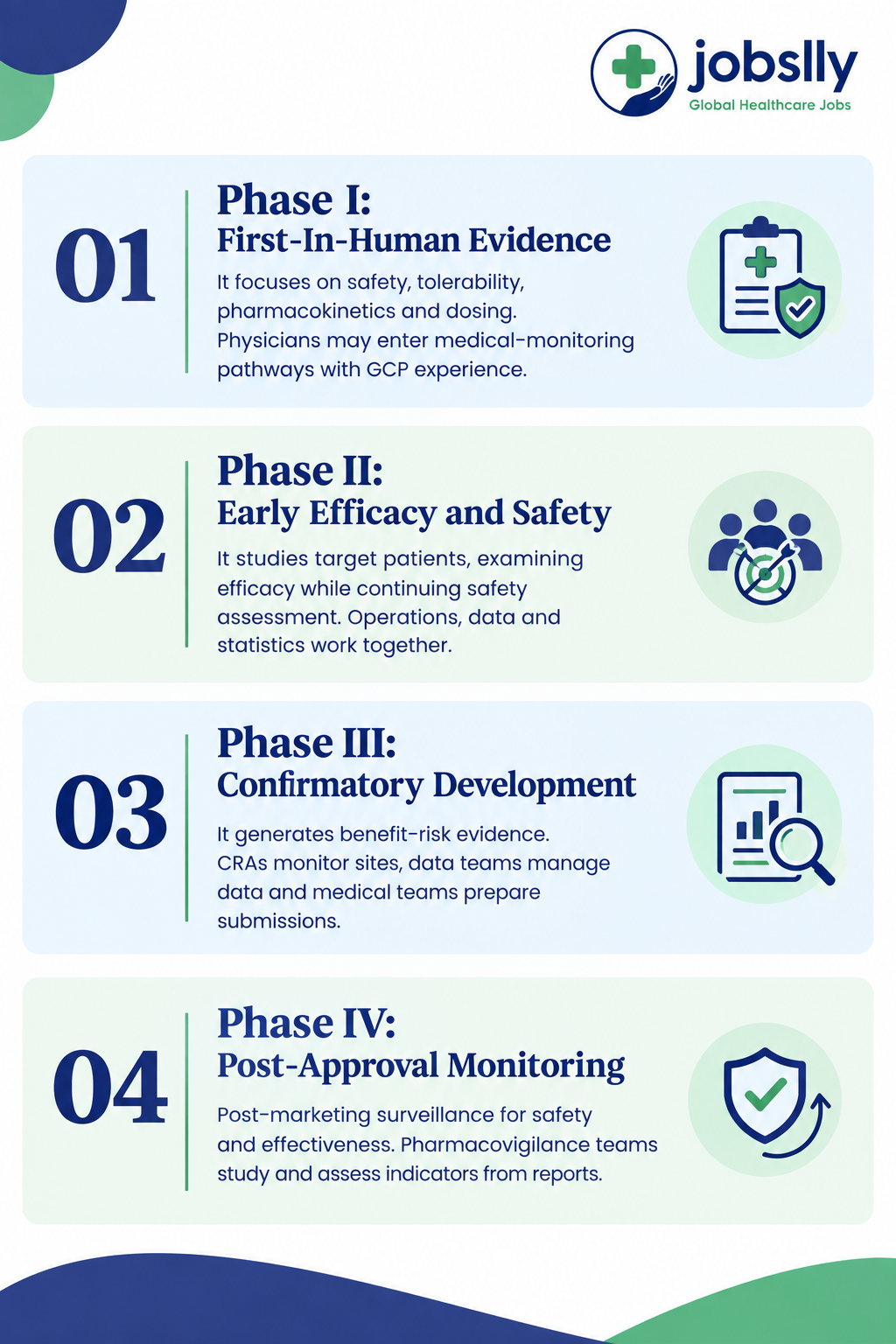
Phase I to Phase IV: Where Do the Jobs Fit?
Stage | Purpose | Roles |
Preclinical | Safety, pharmacology | Pharmacologist, DMPK scientist |
Phase I | Safety, dosing | CRA, coordinator, medical monitor |
Phase II | Efficacy, safety | CRA, data manager, biostatistician |
Phase III | Confirmatory evidence | CRA, project manager, medical monitor |
Regulatory review | Authorisation | Regulatory associate, medical writer |
Phase IV | Post-market safety | PV associate, safety scientist, medical affairs |
Regulatory Touchpoints: IND, CTA and NDA Explained
Regulatory Feature | United States | European Union | India |
Regulatory Authority | U.S. Food and Drug Administration (FDA) | European Medicines Agency (EMA) & National Competent Authorities (NCAs) of Member States | Central Licensing Authority (CLA) / Central Drugs Standard Control Organisation (CDSCO) |
Governing Regulation | Federal Food, Drug, and Cosmetic Act (21 CFR Parts 312 & 314) | EU Clinical Trials Regulation (Regulation (EU) No 536/2014) | New Drugs and Clinical Trials (NDCT) Rules, 2019 |
Clinical Trial Touchpoint | IND (Investigational New Drug) application | CTA (Clinical Trial Application) | Clinical Trial Permission |
Marketing Approval Touchpoint | NDA (New Drug Application) | MAA (Marketing Authorisation Application) | New Drug Permission / Form CT-18 |
Primary Submission Forms & Portals | Form FDA 1571 (IND) & Form FDA 356h (NDA) via FDA ESG Platform | CTIS (Clinical Trials Information System) | Application in Form CT-04, Permission granted in Form CT-06 via SUGAM portal |
Core Submission Requirements | Nonclinical, clinical, manufacturing (CMC), and safety data | Single harmonized submission containing Part I (Scientific/Product) and Part II (Ethical/National) | Protocol, nonclinical/clinical data, CMC, Ethics Committee clearance, and investigator site details |
Who Regulates Clinical Drug Development in India?
The Central Drugs Standard Control Organisation (CDSCO) is central to new-drug and clinical-trial regulation in India. Its New Drug Division processes clinical-trial applications through SUGAM.
The Drugs Controller General (India) is the drug licensing authority referenced by CTRI for mandatory registration of regulatory clinical trials. CTRI, hosted by ICMR-National Institute for Research in Digital Health, provides the public registration system.
Get Industry-Specific Training
Academically's Executive Programme in Clinical Drug Development is designed for MBBS, MD/MS, BDS, MDS, B.Pharm, M.Pharm, Pharm.D, AYUSH, nursing, life-science and biotechnology graduates, including freshers and career-switchers. It runs for four months. The programme is led by Dr. Akram Ahmad, PhD from the University of Sydney, with support from global Clinical Drug Development experts. Its curriculum covers drug development, clinical trials, regulatory affairs, pharmacovigilance, medical affairs, data management, biostatistics, medical writing, GCP, real-world evidence and a capstone. Learners receive mentorship, assignments, interview preparation, resume support and Jobslly job assistance. For some entry-level goals, a four-month programme can provide faster practical exposure than a longer master’s. |
Clinical Drug Development Jobs: Roles, Skills and Salary
Role | Typical work | Skills | Salary in India | Global salary |
Site monitoring and trial oversight | GCP, documentation | ₹5–9 LPA | $60k–$95k | |
Data and database oversight | EDC, CDISC, quality | ₹4/7 LPA | $55k–$85k | |
PV Associate | Safety case processing | MedDRA, safety workflows | ₹4–7 LPA | $55k–$85k |
Submissions and compliance | CTD/eCTD, writing | ₹6–12 LPA | $75k–$115k | |
Medical Writer | Clinical and regulatory documents | Scientific writing | ₹6–10 LPA | $65k–$100k |
Medical Monitor | Medical oversight | Clinical expertise, GCP | ₹20–35 LPA | $130k–$200k |
MSL/Medical Affairs | Scientific exchange | Scientific communication | ₹12–20 LPA | $100k–$150k |
Clinical Drug Development Scope in India
India has a broad pharma and CRO ecosystem.
Pharma examples include: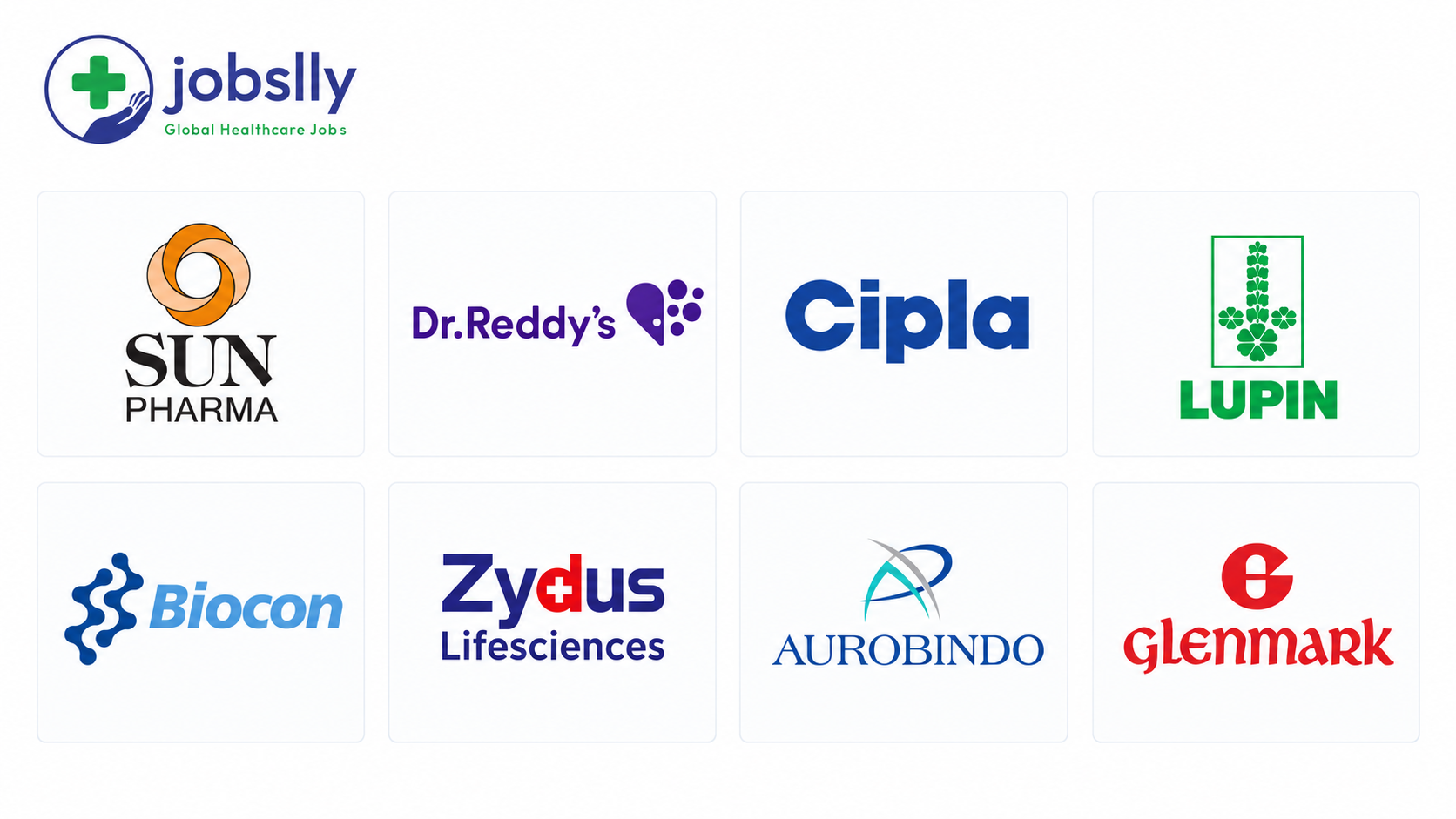
CRO examples include:
India vs Global Career Pathways
Factor | India | Global |
Ecosystem | Pharma, CROs, biotech, research centres | Pharma, CROs, biotech, academic networks |
Regulation | CDSCO, CT-04/CT-06, CTRI, ethics review | FDA, EMA/Member State systems and other national regulators |
Exposure | Indian and global studies | Multinational and jurisdiction-specific projects |
Entry roles | CRA, data, PV, regulatory, medical writing | Similar roles, subject to local requirements |
Skill priority | GCP, documentation, communication, data literacy | GCP plus regional rules and cross-border collaboration |
Global roles may provide multinational exposure, but eligibility and work authorisation differ.
Build Industry Exposure Through Jobs
Training becomes more useful when you apply it to real work.
Jobslly lists healthcare jobs across clinical research, data management, pharmacovigilance, regulatory affairs and medical functions, including CRA, data coordinator, regulatory affairs, patient safety and clinical outcomes roles.
For beginners, seek roles that let you practise documentation, data review, safety workflows or regulatory processes. That experience gives you examples for interviews.
A Practical Career Roadmap
Healthcare degree ↓ GCP basics ↓ Industry training ↓ Applications ↓ ↓ Experience ↓ Senior role |
Looking for Healthcare Jobs?
Browse thousands of opportunities on Jobslly
Find Clinical Drug Development Jobs →