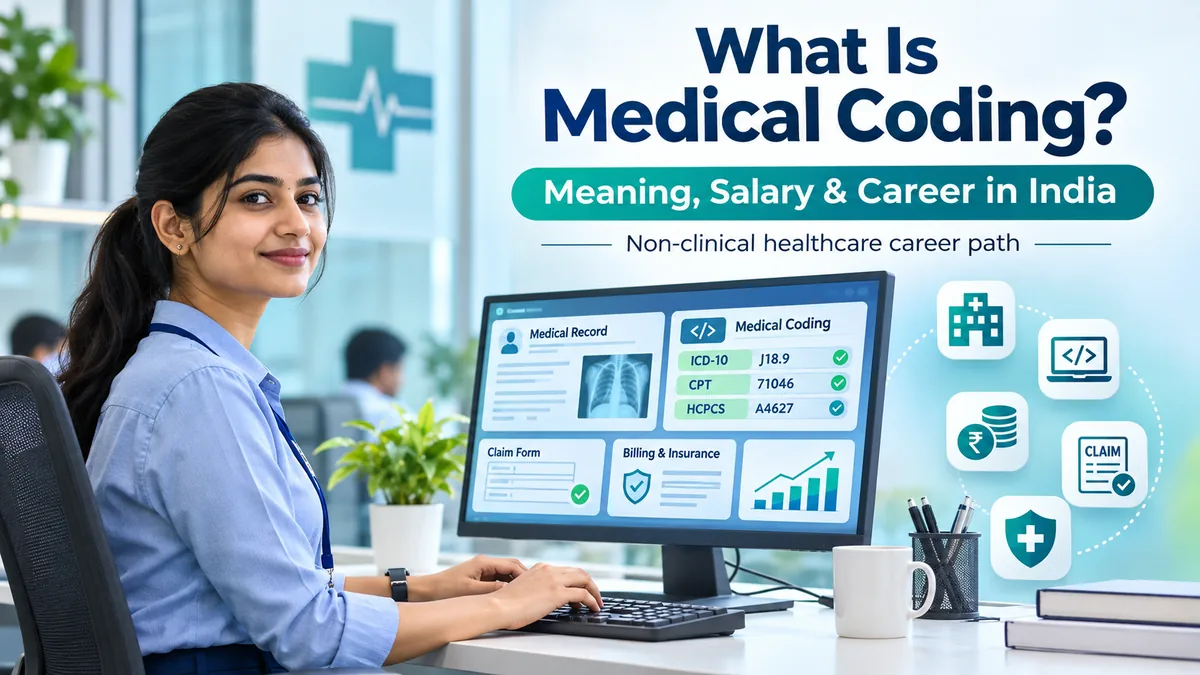


If you've ever looked at a hospital bill and wondered how a long list of treatments became a few lines of numbers, you've already come across medical coding. Most people never see it, but it sits behind almost every insurance claim.
Lately, a lot of students, pharmacy graduates and even doctors in India have been searching for what medical coding means, mostly because it's one of the few non-clinical healthcare jobs you can start without years of extra study. Some only want to know the pay. Others are planning a career switch and want a straight answer before spending money on a course.
This guide covers it all : the medical coding definition, a coder's daily work, the main code sets, job types, salary by experience and city, and how to get started.
Looking for Healthcare Opportunities?
Browse top-paying jobs in hospitals and clinics worldwide.
What Is Medical Coding?
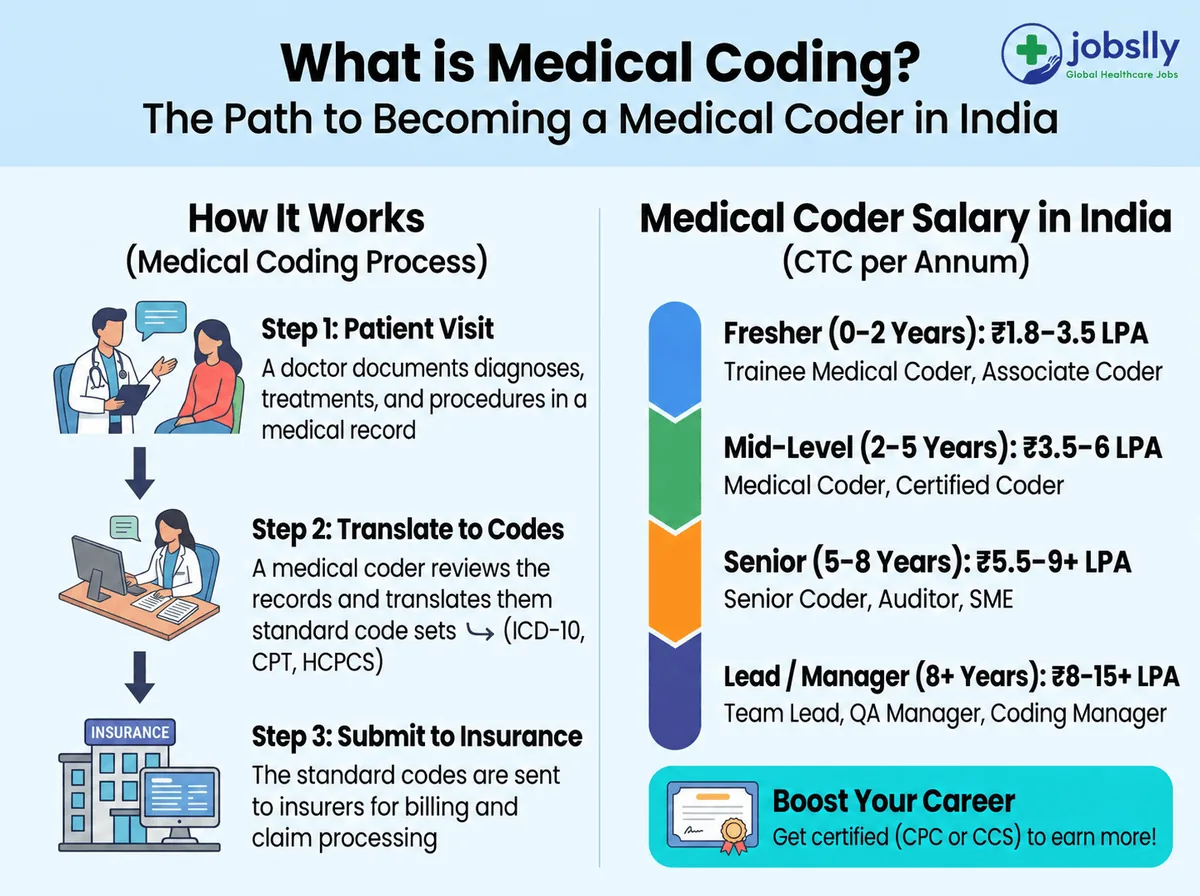
Medical coding means translating what a doctor writes about a patient into universal codes. That covers the diagnosis, the treatment, the tests and any procedures. Each code stands for one specific condition or service, so nobody has to guess what it refers to.
Why does it matter? Insurers and government payers read these codes to decide what they'll pay. If the code is correct, the hospital is paid correctly. “If it’s wrong, then you can deny or delay claim.” That's why medical coding means getting every detail right. It also keeps records consistent, so a diagnosis reads the same whichever hospital or insurer looks at it.
Here's an example. A doctor writes "type 2 diabetes mellitus with diabetic chronic kidney disease." The coder turns that into a combination of ICD-10 diagnosis codes. A knee arthroscopy, on the other hand, gets a CPT procedure code. The coder reads the record, picks the right codes and follows strict coding guidelines.
One thing to be clear about: coders don't treat patients. It's a desk-based, non-clinical career.
Medical Coding Definition
If you need a one-line medical coding definition for an exam or an assignment, here it is: medical coding is the process of converting health records into standard codes that insurers, hospitals and regulators can all read.
Textbooks give a slightly longer medical coding definition, usually about turning diagnoses, procedures, services and equipment into alphanumeric codes. The idea is the same. Doctors write in sentences, while insurers and software work with codes. The coder sits in the middle.
People often mix this up with billing. They're connected, but not identical. Medical coding means choosing the right codes from the record. Billing comes next, when the claim is sent and someone follows up on payment.
Main Code Sets Used in Medical Coding
Not every code does the same job. Coders work with a few main code sets, and learning them is the heart of any training course. Any full medical coding definition covers these sets, because they're the language you read and write every day.
Code set | What it describes | Where it is mainly used |
ICD-10-CM / ICD-10-PCS | Diagnoses (CM) and inpatient procedures (PCS) | US hospitals and payers; ICD-10 is also the global disease classification |
CPT | Procedures and services performed by physicians | Outpatient, physician and surgical billing in the US |
HCPCS Level II | Supplies, equipment, drugs and some services | Medicare and Medicaid billing |
DRG / HCC (risk adjustment) | Groupings used for payment and patient risk scoring | Inpatient payment and health-plan risk adjustment |
A quick note on the table. ICD-10 comes from the World Health Organization, and the US uses its own versions, ICD-10-CM and ICD-10-PCS. CPT is maintained by the American Medical Association, and HCPCS Level II by CMS, the agency behind Medicare and Medicaid. You don't need to memorise this on day one, but it shows why Indian coders spend so much time on US rules. In short, medical coding means learning a rulebook and applying it with care.
What Does a Medical Coder Do Every Day?
Every company runs things a little differently, but this is roughly what medical coding means on a normal workday:
Reads physician notes, discharge summaries, operative reports and test results
Assigns diagnosis and procedure codes by following official guidelines
Queries doctors when the documentation is unclear or incomplete
Meets daily productivity and accuracy targets, which employers audit regularly
Works with billing and claim teams to cut down denials and rework
Targets are a big part of the job. A fresher may have to finish a set number of charts a day, and a quality team checks a sample. Accuracy is measured as a percentage, and 95% or above is common. So it's careful reading at a steady pace, not just speed.
Types of Medical Coding Jobs
Medical coding means different work in different settings, so the type of job you pick affects your pay and growth.
Outpatient / physician coding: clinic and ambulatory visits; often the usual starting point for freshers.
Inpatient coding: hospital admissions using ICD-10-PCS and DRGs; more complex and generally better paid.
Risk adjustment (HCC) coding: reviewing records to capture chronic conditions for health plans; a fast-growing area.
Surgical and specialty coding: orthopaedics, cardiology, radiology, emergency medicine and similar fields.
Auditing and quality: checking other coders' work for accuracy and compliance.
Coding trainer, team lead and manager roles: leadership paths after several years of experience.
Most people start in outpatient coding and move to inpatient or risk adjustment after a year or two. That's the safest route if you want a long medical coding career. The job also changes as you grow. At the junior level, medical coding means coding simple records fast and clean. At the senior level, it means reviewing, auditing and guiding others. Specializing is also the quickest way to grow your medical coding salary.
Want to see which of these roles are hiring? Check current openings on Jobslly.
Medical Coding Salary in India by Experience
Pay depends on the employer, city, certification and specialty. The numbers below pull together published 2026 salary summaries. For example, a Hyring salary model puts the median medical coder at about ₹3.6 LPA, with the 25th to 75th percentile at ₹2.5–5.4 LPA. We've widened the upper bands for certified and specialised coders, so treat everything as indicative, not guaranteed.
Because medical coding means rising responsibility at each level, the pay ladder is fairly clear. Here's what the medical coding salary looks like as you move up.
Level | Experience | Typical roles | Indicative salary (CTC) |
Fresher / Trainee | 0–2 years | Trainee Medical Coder, Associate Coder | ₹1.8–3.5 LPA |
Mid-level | 2–5 years | Medical Coder, Certified Coder | ₹3.5–6 LPA |
Senior | 5–8 years | Senior Coder, Auditor, Subject Matter Expert | ₹5.5–9+ LPA |
Lead / Manager | 8+ years | Team Lead, QA Manager, Coding Manager | ₹8–15+ LPA |
Variable pay, incentives, night-shift allowances and benefits are usually extra and differ by employer. When you compare offers, look at the full package, not only the base figure.
A fresher's medical coding salary can look modest at first. The real jump usually comes after two or three years, once you have certification and clean audit scores.
Medical Coding Salary by City
According to the same Hyring 2027 model, average annual pay is highest in Bengaluru (about ₹5.2 LPA) and Mumbai (₹5.0 LPA), followed by Gurugram (₹4.8), Hyderabad (₹4.6), Delhi and Pune (₹4.4), Noida (₹4.2) and Chennai (₹4.1). Ahmedabad is near ₹3.6 LPA.
Pay isn't everything, though. Because medical coding means working for US-facing companies, jobs cluster in a handful of cities. Chennai, Hyderabad, Bengaluru and Pune have the most openings, so entry-level hiring is strongest there. A city with a slightly lower average but more vacancies can be a better place to start, and you can move later for a higher medical coding salary.
How Qualification and Certification Affect Salary
Your degree decides where you start. Your certification decides how fast you grow.
Background | Where they typically start | Notes |
Life science graduate (BSc, MSc) | Entry band | Large share of coders come from this group |
B.Pharm / M.Pharm / PharmD | Entry to middle band | Drug and clinical knowledge helps in pharmacy-related and risk adjustment coding |
BDS / BAMS / BHMS / MBBS | Middle to upper part of the entry band | Clinical background speeds up learning and suits inpatient, audit and CDI paths |
Any graduate with a certification | Entry band, improves after certification | A recognised certificate matters more than the degree at this level |
Certification is the strongest salary lever. The most recognised credentials are the AAPC CPC (outpatient) and the AHIMA CCS (inpatient), along with CRC for risk adjustment and CPC-A apprentice status for new entrants. Employers often pay certified coders noticeably more than uncertified peers, and many promotions depend on passing the exam and keeping audit accuracy at the required level, commonly 95% or above.
That's because medical coding means following rules that get tested, and a certificate is proof you know them. If you do only one thing to lift your medical coding salary, get certified.
Job Opportunities in India
India is a major hub for US healthcare back-office work, so openings are concentrated in healthcare RCM and BPO companies, global in-house centres, IT-services firms and larger hospitals. Well-known names that regularly hire coders include Optum, R1 RCM, Cognizant, Omega Healthcare, Access Healthcare, GeBBS, AGS Health and Cotiviti, as well as many mid-sized RCM firms. Hiring changes often, so check live listings instead of relying on any fixed list.
Cities with the most roles: Chennai, Hyderabad, Bengaluru, Pune, Mumbai, Delhi NCR and Coimbatore
Many entry-level employers run training-cum-job programmes for freshers
Remote and hybrid work has become common for experienced coders
Demand is supported by US healthcare volumes, ICD-10 and risk adjustment work, though AI-assisted coding is raising accuracy and productivity expectations
That last point deserves a closer look. AI tools can suggest codes now, but a human still has to review them, especially in complex cases. So the work is moving toward checking and auditing, which is one more reason medical coding means more than data entry today.
Browse current medical coding, coding audit and RCM roles on Jobslly and set a daily alert, so you see new openings as soon as they go live.
What Medical Coding Means for Different Backgrounds
The same job looks different depending on where you're coming from.
For a fresher, medical coding means a structured first job in healthcare without a experience. You start in outpatient coding and build speed through audits.
For a pharmacy graduate, medical coding means using your drug knowledge at a desk instead of behind a counter. Risk adjustment and pharmacy-related coding are a natural fit.
For a doctor or dentist, medical coding means a non-clinical route into healthcare , often through inpatient coding, auditing or clinical documentation improvement. Your clinical understanding is a real advantage.
How to Start a Medical Coding Career
Once the medical coding definition makes sense, here's a simple path to follow:
Learn the basics. Study anatomy, medical terminology and basic pharmacology. This decides how comfortable you'll feel later.
Take a recognised course. Choose a programme that prepares you for AAPC CPC or AHIMA CCS and gives you practice on real charts. Ask about placement support, too.
Pass a certification. Even CPC-A status helps freshers stand out.
Practise coding daily. Speed and accuracy are what employers test, and even an hour a day on sample charts builds the habit.
Apply to training-cum-job roles and RCM firms. Expect a written coding test and an interview. Fresher-friendly openings are listed on Jobslly.
Specialise after 1–2 years. Move toward inpatient, risk adjustment or auditing for higher pay.
Is a Medical Coding Career Worth It in India?
It offers a clear entry route for graduates in life sciences, pharmacy, dentist and allied health, steady demand, and a defined growth path from coder to auditor to manager. That's the good side.
The trade-offs are real too: daily targets, shift timings aligned to US hours in many roles, and entry salaries that start modest. If you want patient contact or a relaxed schedule from day one, this may not suit you.
Choosing a specialty and certifying early is what separates fast-growing coders from the rest. So don't judge the field by the first medical coding salary alone. Judge it by where you can be in five years. If medical coding means steady work, a clear ladder and no clinical pressure to you, it's a solid choice.
Start Your Medical Coding Career
Medical coding combines healthcare knowledge with accuracy, and it's one of the more accessible non-clinical entry points in India. Learn the code sets, get certified and apply consistently. Now that you know what medical coding means, how the medical coding salary changes at each level, and what the medical coding definition covers, the next step is yours. Find medical coding and RCM openings on Jobslly.